How to Spy on Your Competition Using Meta Ads Library and Google Ads Transparency
Let’s face it: no matter how original your business idea is, you’re not the only one selling in your space. There are competitors, some you know, some you don’t. And while you shouldn’t obsess over them, you absolutely should watch them.
Because your competitors are giving away clues. Every day. In their ads. In their messaging. In how they’re showing up online.
Thanks to tools like Meta Ads Library and Google Ads Transparency Center, you don’t have to guess what they’re doing, you can see it. Clearly. For free.
So in this post, let’s talk about how to “spy” on your competition ethically and strategically, and how to use those insights to sharpen your own ad strategy.
Why Spying on Competitors Isn’t Sleazy, It’s Smart

Let’s clear this up: you’re not copying anyone. You’re not stealing. You’re not trying to be a knockoff.
You’re studying the market. You’re analyzing trends. You’re identifying what works and what doesn’t. This is the kind of research big brands pay thousands for and now, you can do it from your laptop.
Done right, competitive ad research can help you:
- Spot gaps in your competitors’ messaging
- Avoid repeating their mistakes
- Learn what hooks, visuals, or offers are working
- Find opportunities to stand out
Now, let’s break down exactly how to do it.
Now, let’s break down exactly how to do it.
Tool 1: Meta Ads Library (Facebook + Instagram)
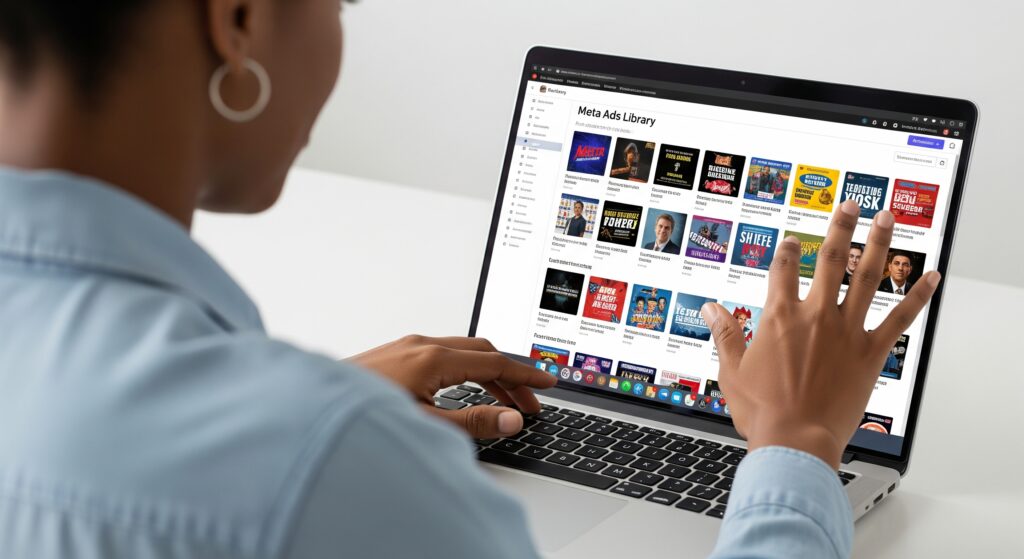
Meta (which owns Facebook and Instagram) created the Ads Library to improve transparency in advertising. It’s a public tool that shows you all active ads being run by any Facebook page.
How to Use It:
- Visit https://www.facebook.com/ads/library
- Select your country (or “All” if you want global visibility).
- In the search bar, type your competitor’s brand name or keyword.
- You’ll see their current active ads, with creative, captions, platforms used, and start dates.
What to Look For:
a) Visual Format
Are they using static images, video, carousels, or reels? This tells you what kind of content they believe is converting best.
Example:
A fitness brand might be running UGC-style videos instead of polished studio ads. That tells you casual, authentic content may be performing better in that niche.
b) Messaging and Hooks
Pay attention to the first line of their ad. Are they starting with a question? A bold claim? A pain point?
This is your window into their testing strategy. If they’re running multiple versions of the same ad with different openers, they’re likely testing which message pulls people in fastest.
c) Call to Action (CTA)
What are they asking people to do sign up, book a call, shop now, learn more?
And are they leading to a landing page, product page, or a lead form?
Tip: If you click on their ad and go through their funnel (without converting), you might also see how they retarget you later.
d) Ad Frequency and Volume
Are they running one or two ads, or dozens? If you see an ad that’s been live for weeks or even months, chances are it’s working for them.
Those are the golden ones to study.
Tool 2: Google Ads Transparency Center
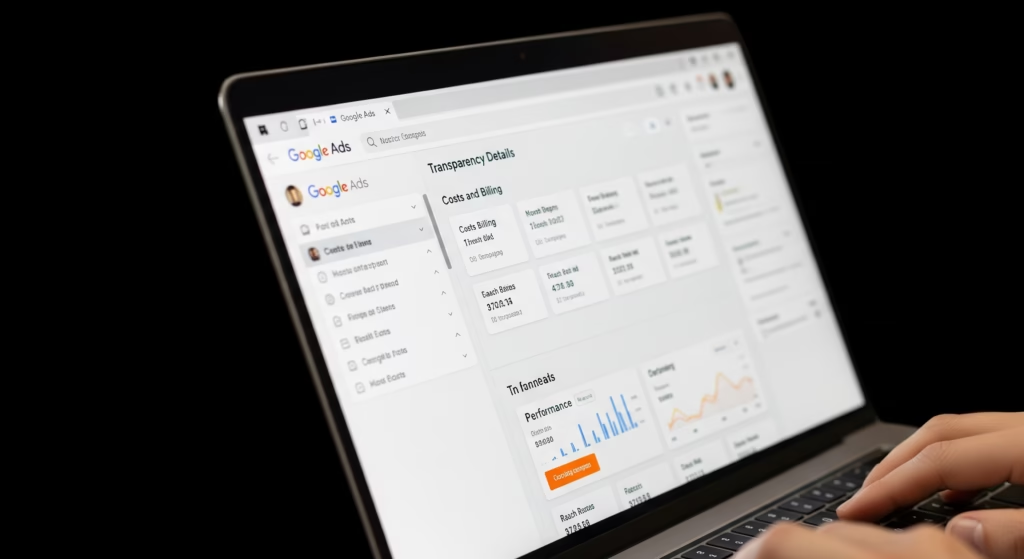
Google launched the Ads Transparency Center in 2023 to let users see who’s running ads across Search, YouTube, and Display.
It’s like Google’s version of the Meta Ads Library and just as powerful.
How to Use It:
- Visit https://ads.google.com/transparency
- Enter a business name or website domain in the search bar.
- Browse the results, which include:
- Ad formats (search, display, YouTube)
- Countries where ads are running
- When each ad was last seen
- Visuals, headlines, and descriptions
- Ad formats (search, display, YouTube)
What to Look For:
a) Search Ads Structure
Search ads give you insight into:
- Keywords they’re targeting
- Headlines they’re rotating
- Landing page strategy
If you notice multiple variations of the same headline, that’s testing. Look at the consistent elements across their ads—that’s their core value proposition.
Example:
A dental clinic running search ads with “Emergency Dental Care Near Me” and “Same-Day Appointments” as repeated headlines is clearly banking on urgency and convenience.
b) Display Ads Creative
Display ads show you the visual identity of a brand. What colors are they using? What emotions do their images tap into? Are they promoting discounts, testimonials, or guarantees?
If you see them testing a “limited-time offer” alongside a “no-risk trial,” you can tell they’re experimenting with emotional triggers.
c) Video Ads on YouTube
YouTube ads tell a deeper story. You can see:
- Script style (educational vs. emotional)
- Video length
- Whether the ad starts with a hook or builds slowly
Tip: Watch how they handle the first 5 seconds—this is where most people skip. The best-performing YouTube ads grab attention fast.
Combining Insights From Both Platforms
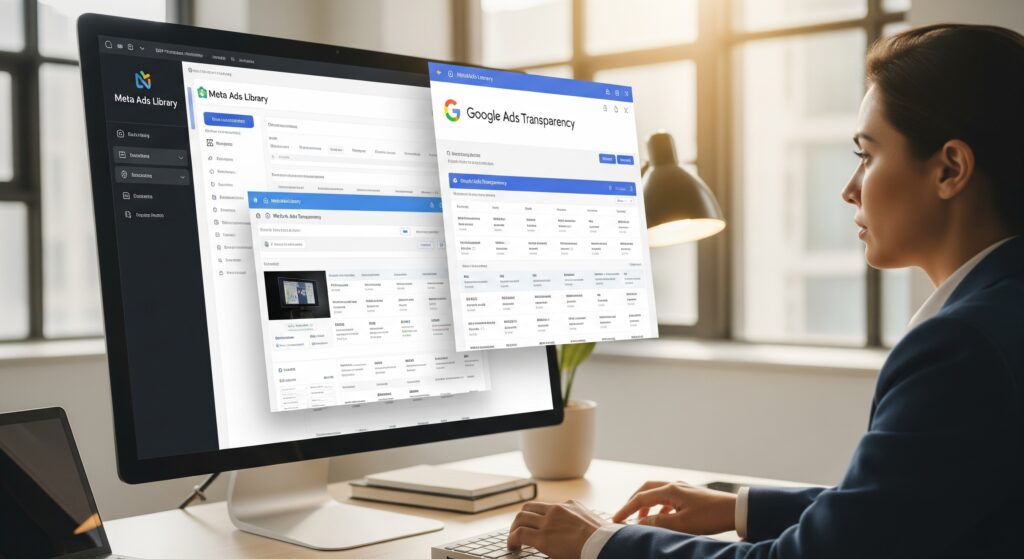
Now you have two powerful tools showing you what your competitors are saying and where they’re saying it.
Here’s how to turn that data into action:
1. Build a Swipe File
Start saving examples of:
- Headlines that grab attention
- Ad creatives that feel different
- Offers that seem to repeat across brands
This isn’t to copy but to inspire. A swipe file keeps your creative muscle sharp.
2. Spot the Gaps
What’s missing in their communication?
- Are they all saying the same thing?
- Is there an audience they’re not speaking to?
- Is their tone too formal or too playful?
Your opportunity often lies in what they’re not doing.
3. Test Opposite Angles
If competitors are pushing speed, maybe you focus on quality. If they’re pushing price, maybe you highlight experience.
Blue ocean thinking starts here positioning yourself differently, not slightly better.
Real-Life Example
Let’s say you run a plant-based protein brand.
You check Meta Ads Library and notice most of your competitors are using:
- Bright packaging shots
- “Clean energy” messaging
- Athlete endorsements
But none of them are targeting busy parents, or highlighting gut health benefits.
You pivot your messaging to focus on “plant protein that’s easy on your stomach and quick to prepare.” Your Meta ads show parents making smoothies before school runs. Your Google search ads focus on “digestive-friendly protein for families.”
That’s how you find your edge. Not by being louder but by being sharper, smarter, and more relevant.
Final Thoughts
Your competitors are showing their cards. Every ad they run reveals something: their messaging, their offers, their targeting strategy, their creative bets.
Thanks to Meta Ads Library and Google Ads Transparency Center, you don’t need a big budget or spy tools to figure it out. You just need curiosity, consistency, and a strategy to apply what you learn.
In marketing, it’s rarely about reinventing the wheel. It’s about knowing where the road is crowded and where there’s a clearer, faster lane.
And sometimes, the best way forward is by studying who’s ahead and then choosing a smarter route.